

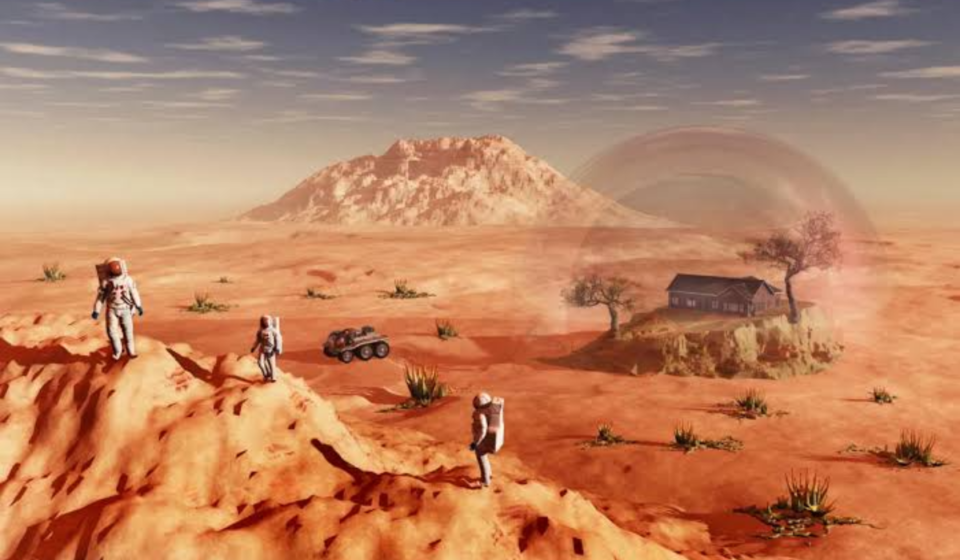

For decades, Mars has captured our imagination as humanity’s next home. Elon Musk talks about colonizing it.
NASA sends rovers to study it.
Movies romanticize it. But strip away the science fiction, and a harder question remains: could humans actually survive there — not just visit, but live?
The answer is complicated.
Mars is both tantalizingly close to habitable and brutally far from it.
The Case for Mars
Mars isn’t a random choice. Compared to other planets, it has some genuine advantages:
A day similar to Earth’s.
A Martian day (called a “sol”) is about 24 hours and 37 minutes — close enough that human circadian rhythms could adapt.
Water exists. Evidence from NASA’s rovers confirms frozen water beneath the surface and in polar ice caps, a critical resource for drinking, growing food, and even producing rocket fuel.
A thin atmosphere still offers some protection.
It’s not much, but it’s more shielding than the Moon has.Gravity is present, if weak.
At about 38% of Earth’s gravity, Mars could reduce some of the muscle and bone loss astronauts experience in zero gravity — though scientists are still studying long-term effects.
The Brutal Obstacles
Here’s where the science gets sobering.
Radiation is the biggest killer.
Mars lost its global magnetic field billions of years ago, which means the planet no longer deflects harmful cosmic and solar radiation the way Earth does. Long-term exposure increases cancer risk and can damage the central nervous system.
Any habitat would need thick shielding — likely built underground or beneath layers of Martian soil.The atmosphere is nearly nonexistent.
Mars’s atmosphere is less than 1% the density of Earth’s, and it’s mostly carbon dioxide. Humans can’t breathe it, and it provides almost no protection from temperature swings or meteorite impacts.
Temperature extremes are severe. Average temperatures hover around -80°F (-62°C), though they can swing wildly between day and night due to the thin atmosphere’s inability to trap heat.Growing food is a serious challenge. Martian soil contains toxic perchlorate compounds that would need to be removed before any crops could grow safely.
Combined with low sunlight and extreme cold, sustainable agriculture would require heavily controlled greenhouse environments.
Psychological isolation is real.
A trip to Mars takes roughly seven months one-way. Combined with communication delays of up to 22 minutes each way, colonists would face extreme isolation, delayed emergency response, and psychological strain unlike anything humans have experienced.
What Would a Mars Colony Actually Look Like?
Most realistic proposals — including NASA’s and SpaceX’s — don’t imagine glass domes under open skies. Instead, early colonies would likely be:Underground or soil-covered habitats to block radiationSealed, pressurized environments with artificial atmospheresHydroponic or aeroponic farms grown indoors under LED lightingWater extracted from ice deposits, purified and recycled repeatedlyNuclear or solar power systems, since sunlight on Mars is about 60% weaker than on EarthIn other words, less “New Earth” and more high-tech underground bunker — at least for the first generations of settlers.
So, Could We Really Live There?
Technically? Yes — with enough engineering, resources, and time, a self-sustaining colony is theoretically possible. Scientifically?
We’re still decades away from solving radiation shielding, closed-loop life support, and long-term psychological health at scale.Mars isn’t a backup Earth waiting to be unlocked.
It’s closer to a hostile frontier that would demand humans fundamentally change how they live — for survival, not comfort.
Whether that future arrives in 20 years or 200, one thing is certain: making Mars habitable will be one of the greatest engineering challenges our species has ever attempted.
Looking for more free tools to make your day-to-day easier? https://fast-convert.net offers a range of free browser-based utilities, including fast and simple file conversions with no installation required.
Published: August 23, 2026 — From James Carter — Your trusted source for honest tech guides
l



Hi.
It is great one
Hi
Thanks
Of course we can’t live in so far