
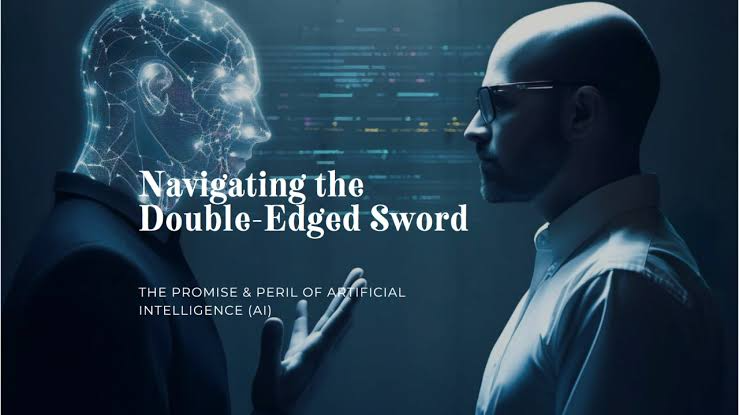

Artificial Intelligence has evolved from a futuristic concept into a daily reality, reshaping industries, societies, and the very nature of work. From smart assistants and recommendation algorithms to advanced generative AI and autonomous systems, AI is everywhere — and its influence grows by the day. But as with any revolutionary technology, AI is a double-edged sword: it brings extraordinary benefits while carrying significant risks, especially when it comes to people and their livelihoods. Understanding both sides is essential to navigating the AI age wisely.
✅ The Benefits: Empowering People and Transforming Lives
🚀 Boosting Productivity and Creativity AI acts as a powerful force multiplier for human ability.
It automates repetitive, tedious, and dangerous tasks — freeing people to focus on creativity, strategy, and emotional intelligence, areas where humans truly shine. Writers use AI to brainstorm ideas and draft outlines; designers leverage it to explore concepts; developers accelerate coding workflows; researchers analyze vast datasets in seconds instead of months. AI does not replace human talent — it amplifies it, allowing people to achieve more in less time.
🩺 Improving Daily Life and Services AI improves quality of life in countless ways. In healthcare, AI assists doctors in diagnosing diseases earlier and more accurately, analyzing medical images, and personalizing treatment plans. In education, intelligent tutors adapt to each student’s pace, making learning accessible to anyone, anywhere. In transportation, AI powers navigation systems that reduce congestion and enhance safety. For people with disabilities, AI tools — from voice assistants to real-time language translation — create new levels of independence and inclusion.
📈 Creating New Opportunities and Jobs While AI transforms work, it also creates entirely new industries and career paths that did not exist a decade ago. Prompt engineers, AI trainers, ethics consultants, and AI integration specialists are just the beginning. By handling routine tasks, AI enables workers to upskill, focus on higher-value work, and explore roles that require empathy, critical thinking, and human connection — skills no machine can replicate.
⚠️ The Risks: Challenges to Society and Employment
📉 Job Displacement and Economic Uncertainty
The most discussed concern is job displacement. Roles centered on repetitive, rule-based tasks — data entry, basic customer service, routine manufacturing, and even some forms of content creation — are at risk of automation. For workers in these fields, especially those without access to training, the transition can be sudden and difficult. Without proper planning, AI could widen the gap between those who control the technology and those who are replaced by it.
🤖 Bias, Misinformation, and Loss of Human Judgment AI systems learn from human data — and they inherit human flaws.
If training data is biased, AI will produce biased outcomes, affecting hiring decisions, loan approvals, and law enforcement.
Generative AI can create hyper-realistic images, audio, and text, making misinformation and deepfakes easier to produce and harder to detect. Over-reliance on AI also risks eroding critical thinking skills: when people trust AI answers blindly, they lose the ability to question, verify, and think independently.
🛡️ Privacy, Security, and Social Isolation AI thrives on data — often personal data collected without full awareness. Facial recognition, predictive analytics, and behavioral tracking raise serious privacy concerns. Cybersecurity risks grow too: AI-powered attacks can find vulnerabilities faster and at scale. Socially, overuse of AI-driven interactions may reduce face-to-face human connection, weakening the empathy and trust that bind communities.
🔭 The Future:
Collaboration Over Replacement The most important truth about AI is this: it will not replace people — but people who use AI will replace those who do not. The future belongs not to machines alone, but to human-machine collaboration. The best outcomes happen when AI handles data, speed, and repetition, while humans bring creativity, ethics, empathy, and judgment. To maximize the benefits and minimize the harm, we need action from all sides. Governments must update labor laws, invest in education, and regulate AI to ensure fairness. Companies must be transparent about AI use, support workers through transitions, and design tools that augment rather than replace human roles. Individuals must embrace lifelong learning, develop uniquely human skills, and stay critical and curious.
📝 Conclusion
Artificial Intelligence is neither inherently good nor inherently bad — it is a tool, and its impact depends entirely on how we choose to build, regulate, and use it. It has the power to cure diseases, solve climate challenges, and unlock human potential on a global scale. But it also carries real risks: job disruption, inequality, bias, and privacy loss. The solution is not to fear or ban AI — but to shape it, guide it, and work alongside it. By balancing innovation with empathy, and progress with responsibility, we can build a future where AI lifts everyone up, not just a privileged few.
Looking for more free tools to make your day-to-day easier? https://fast-convert.net offers a range of free browser-based utilities, including fast and simple file conversions with no installation required.
Published: August 19, 2026 — From James Carter — Your trusted source for honest tech guides