

Have Scientists Finally Found Dark Matter? Inside the LUXZEPLIN Signal Everyone’s Talking About

A single flash of light, recorded nearly a mile underground in an old South Dakota gold mine, has physicists around the world talking. It’s not a discovery yet — scientists are careful to stress that — but it’s being called the most intriguing signal in the decades-long hunt for dark matter.
What Actually Happened
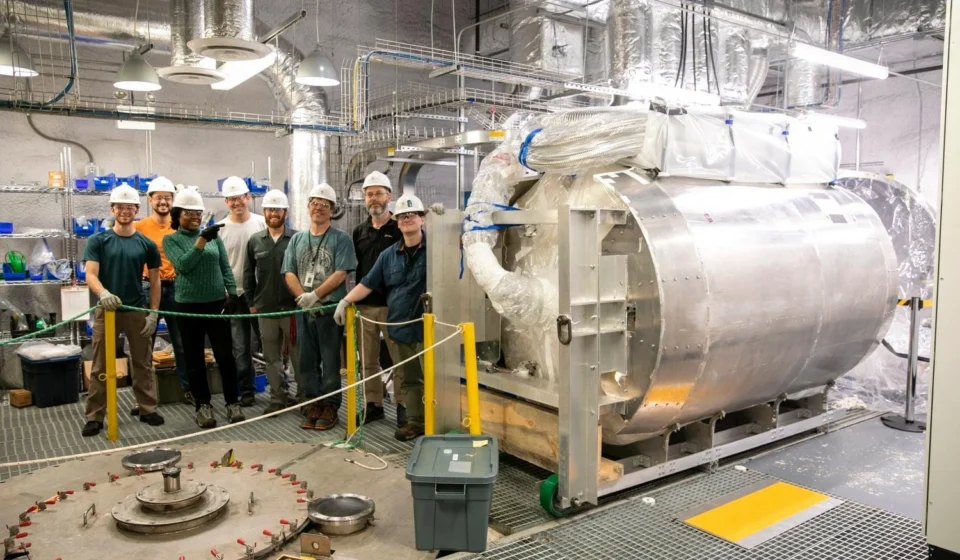
The signal came from the LUX-ZEPLIN (LZ) experiment, the world’s most sensitive dark matter detector, buried 1,480 meters underground at the Sanford Underground Research Facility to shield it from cosmic radiation. Announced at the TeV Particle Astrophysics conference in Japan, the event is a single particle interaction that doesn’t cleanly match any known source of background noise.
Physicists working on LZ have been careful with their language. As one of the project’s co-founders put it, a single event is genuinely difficult to interpret — the team has spent considerable time trying to understand exactly what it could be before deciding it was worth sharing publicly.
Why Dark Matter Is Such a Big Deal
Dark matter is one of the largest unsolved mysteries in physics. Observations of how galaxies rotate and cluster suggest they’re embedded in far more mass than we can actually see. Studies of the cosmic microwave background — the faint afterglow of the Big Bang — indicate that this invisible material makes up roughly 85% of all matter in the universe.
The catch is that no known particle fits the bill. Dark matter doesn’t emit or absorb light, so it can’t be detected the way ordinary matter is. For decades, the leading theoretical candidate has been a class of particles called WIMPs — Weakly Interacting Massive Particles — which would be heavy enough and rare enough in their interactions to explain dark matter’s gravitational effects while remaining essentially invisible to every instrument we’ve built so far.
How LZ Is Built to Catch One
LZ works by watching roughly 10 metric tons of ultra-pure liquid xenon, waiting for the rare possibility that a WIMP passing through Earth might bump into a xenon nucleus and produce a tiny, detectable flash. The setup is deliberately extreme: the xenon is kept in a supercooled tank, surrounded by layers of shielding designed to filter out cosmic rays, radioactive decay, and any other particle that isn’t the one they’re looking for.
That’s what makes this particular event notable. It passed through nearly every filter the LZ team uses to rule out ordinary background noise, leaving them with a signal that — at least for now — doesn’t have an obvious conventional explanation.
Why Scientists Are Still Cautious
Particle physics has a long history of promising single-event signals that faded once more data came in. A single detection, however unusual, isn’t enough to overturn decades of searching that has so far come up empty in similar experiments. Researchers need many more events, ideally with a clear statistical pattern, before they can rule out a rare but ultimately mundane explanation.
The LZ collaboration is continuing to collect data and has already amassed the largest dark matter dataset ever recorded. Every additional month of running the detector either strengthens the case that this signal is meaningful or reveals it as one of many false alarms in the field’s history.
Bottom Line
If future data reinforces this signal, it would be one of the most significant discoveries in modern physics — direct evidence for the particle that makes up the majority of the universe’s matter. If it doesn’t, LZ will simply continue tightening the constraints on where dark matter can and can’t be hiding, work that’s valuable to the field even without a headline-grabbing discovery.
Either outcome pushes physics forward. For now, the honest answer is the one researchers themselves are giving: it’s the most compelling hint yet, but a single event, however strange, isn’t a discovery — it’s a reason to keep watching closely.